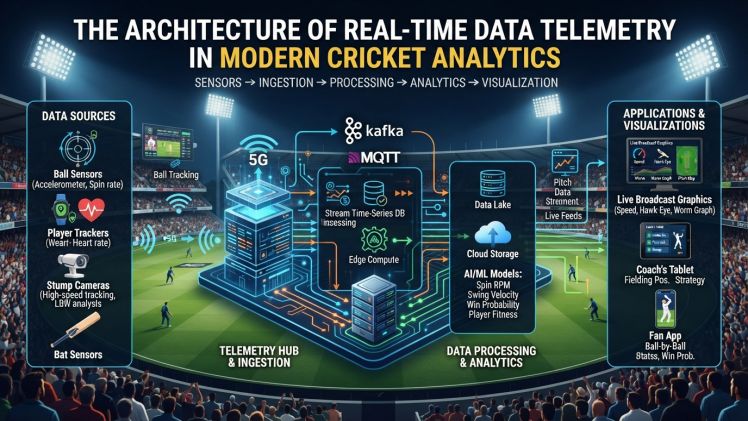
Digital sports publishing and fan engagement platforms have undergone a structural shift over the past decade. Where audiences once relied on delayed broadcast television summaries and morning newspaper match reports, contemporary sports media operates in a regime of continuous, real-time statistical streaming. In professional cricket, where a single ball can dramatically shift win probabilities, the delivery of instantaneous match telemetry has become a baseline requirement for media networks, analytics firms, and digital gaming hubs.
Processing thousands of live data points during an ongoing fixture requires robust data ingestion protocols, cloud-based aggregation servers, and highly optimized frontend user interfaces. The interaction between on-field optical sensors and consumer devices involves complex operational workflows designed to maintain accuracy under heavy concurrent server loads.
Technical Infrastructure Behind Real-Time Match Streaming and Odds Delivery
Modern sports telemetry relies on distributed data collection networks deployed directly at venue stadiums. Systems like Hawk-Eye optical ball-tracking, radar-based speed sensors, and manual official scoring consoles capture every physical metric of a delivery within milliseconds. These raw data points are standardized into JSON payloads and transmitted via high-throughput API endpoints to centralized data distribution networks managed by specialized providers such as Sportradar or OPTA. From these hubs, the data is pushed out to third-party digital channels using WebSockets or Server-Sent Events, eliminating the overhead of traditional HTTP polling requests.
When users monitor active matches on digital platforms, live statistical engines ingest telemetry from venue scoring terminals to refresh win probabilities and match states instantly. For instance, platforms providing updates on desi betting cricket live rely on low-latency data pipelines that process ball-by-ball events alongside fluctuating market parameters, reflecting real-time match dynamics such as boundary hits, wickets, and changing weather conditions without manual editorial delay. This seamless synchronization between raw match scoring and frontend dashboards prevents data drift during high-volume sports tournaments like the Indian Premier League or international Test series.
To maintain real-time accuracy during traffic spikes, server infrastructures utilize edge computing nodes situated close to major consumer regions. By distributing computing tasks to regional edge servers, platforms minimize physical network hops, reducing delivery latency from several seconds to under three hundred milliseconds. This technical framework guarantees that ball trajectory changes, run-rate calculations, and player fatigue indicators render simultaneously across global user applications.
Core Telemetry Categories and Analytical Workflows
The raw information collected during a professional cricket match falls into three distinct analytical categories: physical spatial telemetry, tactical match metrics, and predictive probability modeling. Each stream serves a specific purpose in evaluating team performance and generating real-time broadcast visuals.
| Telemetry Category | Primary Sensor Source | Target Analytical Output | Update Frequency |
|---|---|---|---|
| Spatial Ball Tracking | Multi-camera optical arrays | Pitch spot, bounce height, deviation angle | Per delivery (sub-second) |
| Player Biometrics | Wearable GPS and accelerometers | Distance covered, sprint intensity, stamina reserves | Continuous stream |
| Match Situation State | Scorekeeper terminal input | Required run rate, DLS targets, win index | Immediate upon event |
Spatial tracking systems measure ball velocity, seam orientation, and release points from the bowler’s hand. Analysts use these parameters to map pitch behavior over multiple days of a Test match, identifying whether a pitch is breaking down or offering variable bounce. Simultaneously, tactical scoring models process run rates and boundary percentages, allowing predictive algorithms to calculate Duckworth-Lewis-Stern (DLS) adjustments during rain interruptions without manual calculation errors.
Integration of these data streams into unified analytical models enables automated insights generation. Broadcast graphics packages ingest the telemetry feed to display instant trajectory overlays, while digital publications use automated natural language processing (NLP) scripts to generate live text commentary summaries within seconds of a wicket falling.
Managing System Latency and Network Overhead During Marquee Events
High-profile international matches generate massive concurrent traffic, placing intense demand on digital delivery architectures. Scaling real-time dashboards to accommodate millions of concurrent sessions without experiencing memory leaks or connection drops requires disciplined software engineering.
- Payload Minimization: Data providers strip non-essential metadata from WebSocket messages, transmitting only differential changes (deltas) rather than full match state objects for every delivery.
- Client-Side Rendering: Frontend applications use lightweight frameworks to process raw JSON streams directly in the browser DOM, reducing server-side HTML rendering tasks.
- Fallback Polling Protocols: When socket connections drop due to local mobile network instability, client software gracefully degrades to adaptive HTTP long-polling to maintain continuous score updates.
These architectural choices prevent application freezing and reduce bandwidth consumption for mobile users on cellular networks. Maintaining payload efficiency ensures that interactive elements, such as dynamic wagon wheels and pitch maps, update smoothly even under constrained network conditions.
Operational Challenges in Automated Live Data Integrity
Despite advancements in hardware and network transmission, live data pipelines face persistent operational challenges. The primary vulnerability in real-time sports telemetry remains human scoring input reconciliation. While camera arrays operate automatically, official match states—such as dead balls, no-balls called for foot overstepping, or umpire review signals—require human confirmation before data feeds lock in the outcome of a delivery.
When discrepancies occur between automated sensor readings and official scorekeeping entries, reconciliation algorithms must resolve conflicts without introducing perceptual lag for the viewer. Data management systems implement brief validation windows—typically lasting between two and four seconds—where event states remain marked as provisional until secondary scoring feeds verify the result. If an umpire review reverses an on-field decision, the database issues an immediate rollback payload that updates client state stores across all connected devices simultaneously.
The Long-Term Evolution of Data-Driven Sports Coverage
The migration toward real-time telemetry has permanently reshaped digital sports media and audience expectations. Sports journalism and digital analysis have moved past static post-game reporting, evolving into interactive media environments powered by continuous data streams. As machine learning models become more adept at processing multi-modal sensor inputs, future platforms will offer predictive insight depth previously reserved for elite coaching staffs. Platforms that master the technical discipline of low-latency data transmission, resilient network scaling, and precise telemetry display will continue to set the standard for modern sports information delivery.