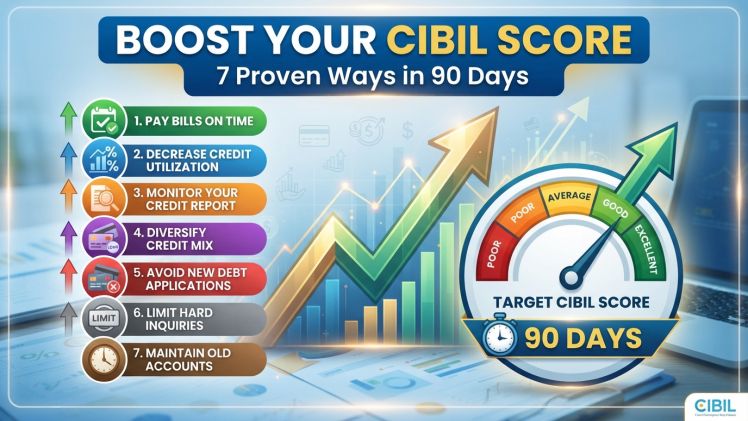
A high CIBIL score, preferably 750 or more, is what easily opens the door to speedy loan disbursements, although some lenders also start offering loans at a score of 650. A score of 750 and above brings in higher borrowing amounts and low-interest rates in India.
If your CIBIL score has been fluctuating lately, you need not wait for a couple of years to see the results. As banks and NBFCs report credit information to TransUnion CIBIL on the 9th, 16th, 23rd and last day of the month, it offers several intervals for you to move ahead with your plan.
This guide below walks you through how you can improve your CIBIL score with disciplined financing habits.
1. Check Your CIBIL Report and Dispute Errors
Before any alterations, you have to understand your position. You can obtain a free copy of your CIBIL score from the Bajaj Finserv app within minutes by just providing your PAN and mobile numbers. And this is going to be a soft inquiry; thus, there is no effect on your credit score.
Now, when checking for any inaccuracy in your report, look out for:
- Closed loans/credit cards shown as open/overdue
- Errors in personal information or unknown loans
Regarding incorrect payment status, if you do find a mistake, then file a dispute on the official CIBIL website right away. The credit bureaus usually take 30 days to resolve the dispute; hence, you may obtain a quick boost to your score.
2. Pay Every EMI and Bill on Time
Your repayment history is you. A missed credit card bill or a late EMI can bring your score down, and that will stay on your report for years. If someone misses a loan payment, for example, that mark will remain on their credit file for up to 7 years.
During your 90-day reset, 100% on-time payments are absolutely essential. Set up auto-debit mandates to clear your credit card bills, loan EMIs, and utility bills before they come due. Three months in a row of perfect repayments will be a very strong signal to the lenders that you are a reliable borrower.
3. Keep Credit Usage Below 30%
Your Credit Utilisation Ratio (CUR) indicates the portion of your available credit limit that you’re currently utilising. The more you utilise your credit cards (even if you settle the full amount), the more it suggests a need for credit, which can negatively impact your score. Strive to maintain your overall credit utilisation below 30%. For example, with a total credit limit of ₹1,00,000, you should limit your spending to ₹30,000 in any given billing cycle. A smart approach is to pay down your card balance twice a month over 90 days, ensuring that your balance is quite low when it’s reported to CIBIL after the statement closes.
4. Request a Credit Limit Increase
If your monthly spend makes it difficult to stay below 30% utilisation, contact your card issuer and request a credit limit increase. If your limit goes from ₹1,00,000 to ₹1,50,000 and your spend remains at ₹30,000, your utilisation ratio will drop from 30% to 20% instantly. Just keep in mind that the higher limit is a buffer for your score, not a green light to spend more.
5. Pause New Loan and Credit Card Applications
Each time you apply for a new loan or credit card, an enquiry is made on your credit report, and that is called a hard enquiry. If you make multiple hard enquiries in a short period of time, you may be seen as desperate for credit, which can negatively affect your score for some time.
Do not apply for any new credit during the next 90 days. While researching, you can explore the pre-approved credit offers on a personal loan platform. It will be based on soft inquiries and will not impact your credit report.
6. Clear Overdue Balances and Avoid Settled Status
If you do have any past-due amounts on your account, pay them off in full in the first month. Don’t go in for a loan settlement where the lender will accept less than the full amount. A settlement will close the account, but CIBIL will show it as settled rather than closed, which can have a massive negative impact on your credit history with future lenders. Always aim to pay the full amount and get a No Objection Certificate (NOC).
However, in case there are any arrears on your account, try settling those completely in one go in the very first month. Avoid the option of loan settlement, where the lender would settle for a smaller sum. Loan settlement might close the account, but it would be marked as settlement and not closure by CIBIL. It could have a huge adverse effect on your credit history in the hands of future lenders.
7. Keep Your Oldest Credit Cards Active
Your credit history length is worth about 15% of your score. Closing an old, inactive credit card removes that card’s positive history and reduces your total available credit. Both factors can negatively impact your score. Keep your oldest, no-fee card open and use it once a month for one small recurring bill to keep it alive.
Your 90-Day CIBIL Action Checklist
- Month 1: Check your free score on personal loan apps and dispute any errors you see in the report, pay off any overdue balances and keep your credit card usage below 30%.
- Month 2: Keep the 100% on-time payments going (via auto-debit), ask for a credit limit increase and don’t apply for any new credit.
- Month 3: Check that any disputes have been resolved on your updated report and monitor your score improvement.
To Sum Up
Improving your CIBIL score in 90 days isn’t as complicated as you might think; it’s just disciplined habits across consecutive billing cycles. You can begin your improvement journey by checking your current score on the Bajaj Finance App and setting your benchmark to build a healthier credit profile.