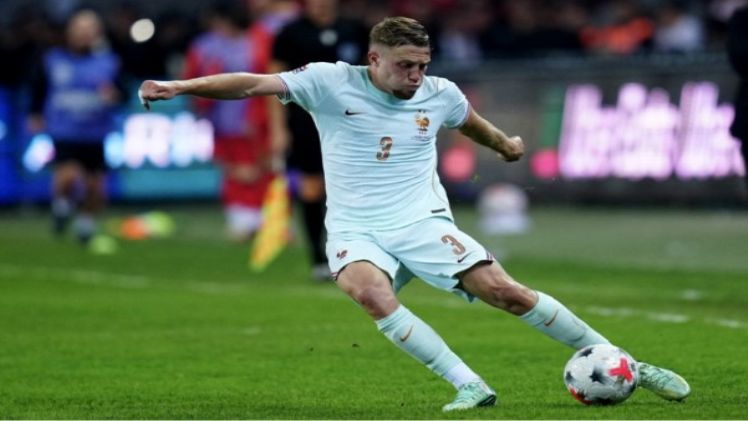
According to 90phut Adrien Truffert’s career is a study in continuity interrupted by ambition. For a decade, he belonged to Rennes—rising from the academy to captain, accumulating nearly 200 professional appearances, and earning a reputation as one of Ligue 1’s most reliable left-backs. Then, at twenty-three, he chose the Premier League. This listicle traces the defining milestones of a career that has been both patient and decisive.
1. A Belgian Birth, a French Footballing Education
Adrien Lilian Gaëtan Truffert was born on 20 November 2001 in Liège, Belgium, but his footballing identity was formed in France. His family settled in the Chartres region, and he began playing at ES Jouy Saint-Prest before joining C’Chartres Football in 2011. At fourteen, he entered the Rennes academy, the club that would shape the next decade of his life.
The early years were not defined by headline moments. They were defined by repetition: youth matches, tactical instruction, and the slow accumulation of technical habits that would later make him a professional. Rennes’ academy is known for producing composed, intelligent footballers, and Truffert absorbed that ethos. By the time he signed his first professional contract in 2020, at eighteen, he had already been shaped by five years of institutional patience.
2. The Rennes Breakthrough and the Captain’s Armband
Truffert made his first-team debut for Rennes in 2020 and never relinquished his place. Across five senior seasons, he played 191 matches in all competitions, scoring nine goals and providing twenty-three assists. Those numbers describe a modern full-back: not a prolific scorer, but a consistent creator, a player whose value lies in progression and delivery rather than finishing.
His importance grew with each manager. From Bruno Genesio to Julien Stéphan, Truffert established himself as the undisputed left-sided defender, and under Habib Beye he was made club captain. Captaining Rennes was not a ceremonial honour. It was a recognition of temperament—the same reliability that had made him a fixture in the starting eleven, season after season, despite changes on the bench and in the boardroom. When he departed in June 2025, Rennes described him as “a symbol of longevity” and “exemplary” in his conduct.
3. A Modern Full-Back With Two Functions
Truffert’s playing profile is best understood through his adaptability. He is a left-back by training, but he has played as a left wing-back in a back-five system and as a left winger when tactical demands shifted. This versatility is not a compromise; it is a competitive advantage. In a back four, he defends the flank with discipline and joins attacks selectively. In a back five, he provides width and crossing. Further forward, he becomes a direct runner capable of scoring and assisting.
See more: Trực Tiếp Bóng Đá 90Phut TV Free Full HD
Bournemouth’s recruitment described him as “a modern, forward-thinking full-back known for his pace, intelligence, and ability to impact both ends of the pitch”. The analytical language matters: pace and intelligence are not opposing qualities. Truffert’s speed allows him to recover defensively and overlap offensively, while his decision-making—honed over five seasons of Ligue 1 football—tells him when to do which. At 173 centimetres and around 70 kilograms, he is not a physically imposing defender, but his mobility and anticipation compensate for what he lacks in aerial dominance.
4. International Recognition and the Olympic Silver
Truffert’s international path followed the French system’s established ladder. He represented France at Under-18, Under-19, and Under-21 levels, accumulating caps and experience at each stage. The culmination of his youth career was the Paris 2024 Olympic Games, where he was part of Thierry Henry’s squad that won silver.
His senior debut arrived in September 2022, as a substitute in a 2–0 defeat to Denmark. It was a single cap, not a breakthrough, but it placed him in the senior international conversation. The Olympic silver medal, meanwhile, offered something different: the experience of a tournament, the pressure of knockout football, and the confirmation that he could perform in a collective built for a specific moment. These are not trivial credentials for a player stepping into the Premier League’s weekly demands.
5. The Bournemouth Move and the Kerkez Shadow
Bournemouth signed Truffert in June 2025 for a fee of £11.4 million, rising to £14.4 million with add-ons, on a five-year contract. The transfer was widely interpreted as succession planning: Milos Kerkez was heavily linked with Liverpool, and Truffert arrived as a ready-made replacement.
The early evidence suggests the adaptation has been smooth. He made his Premier League debut against Liverpool on 15 August 2025 and featured in thirty-eight league games in his first season, scoring once and providing five assists. By the 2026/27 campaign, he had started every league match, an ever-present in a Bournemouth side competing for European qualification. The move was also a full-circle moment: as a child, Truffert had taken his first steps on Bournemouth beach during a family stay on the south coast for his father’s work. He had even taken two years of English lessons before arriving, preparing for a league he had long wanted to play in.

6. The Next Chapter: Ambition Beyond Stability
At twenty-four, Truffert has already achieved what many footballers never do: a decade at one club, a captaincy, an Olympic medal, a senior international cap, and a move to the Premier League. The next chapter is not about arrival; it is about elevation. Bournemouth’s project under Andoni Iraola is built on aggressive, vertical football, and Truffert’s profile fits that system. But the Premier League is unforgiving of players who plateau. The question is whether he can convert reliability into distinction—whether the consistent full-back can become a decisive one.
Conclusion: The Quiet Architecture of a Career
Adrien Truffert’s biography is not a story of explosive talent or dramatic reinvention. It is a story of steady architecture: a decade of academy work, five seasons of first-team proof, and a transfer timed for growth rather than escape. He has been a captain, an Olympian, and a Premier League regular. What remains unwritten is the legacy he builds at Bournemouth—and whether the player who spent ten years becoming reliable can spend the next ten becoming exceptional.